Rosy-finch Drama

| | Comments (0) | TrackBacks (0)
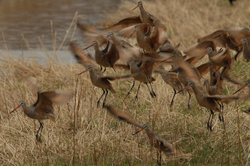
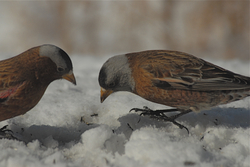
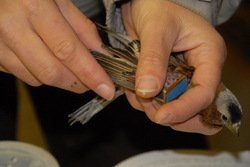
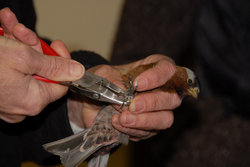
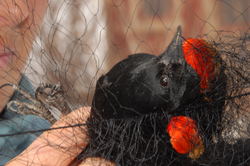
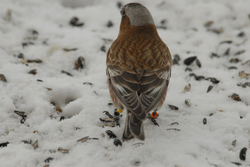
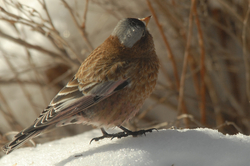
During some winters, we are inundated with flocks of rosy-finches.  This year they showed up on New Years Day as we were watching (appropriately enough) the Rose Bowl Parade. Three different species of rosy-finches populate Northwest Colorado- Gray-crowned, Brown-capped, and Black. While all three species have made an appearance at our feeders this winter, the Gray-crowned Rosy-finches are, by far, the most numerous. Gray-cr.jpg

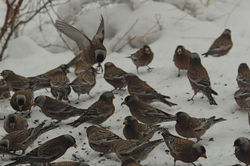
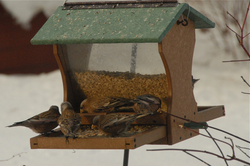
The first few days I counted only 6 or 7 at the feeders in the early morning hours.  Within a week at least two dozen visited each day. Now more than a hundred rosy-finches consistently are seen roosting and feeding around the yard.  They wait their turn on the roof of the buildings and on tree branches, then, fly to the feeder to gorge on sunflower seeds.


Rosy-finches at feeder.jpg


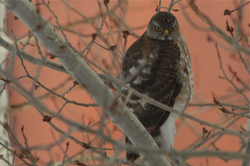
When flocks of rosy-finches abound, a predator is likely to take notice.  Within the last few days, another visitor has shown up at our feeder- a beautiful, sleek Coopers Hawk.  


Coopers Hawk glaring.jpg                         
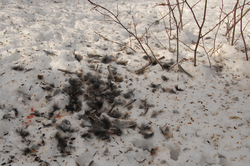
And here is the inevitable result......


feathers.jpg


Sad, but part of what you have to expect when you feed birds!


Crane Count

| | Comments (2) | TrackBacks (0)
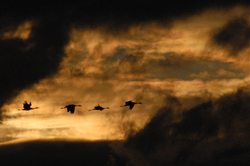
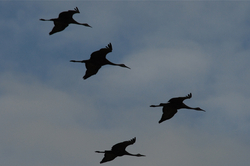
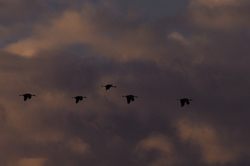
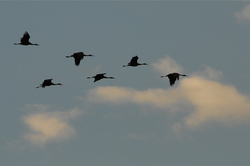
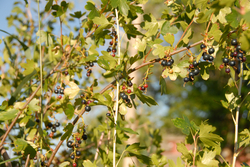
The Sandhill Cranes stage in our area in late summer and early fall before heading south to New Mexico and Arizona for the winter.  We flood one or more of our hay fields in late August to attract them to our ranch.  Every morning at sunrise they fly out from their roosting site along the river to feed in our fields and those of the surrounding ranches.  Every evening at sunset they fly back to the river to spend the night.  The Sandhill Cranes in our area are part of the Rocky Mountain Flock and are of the subspecies known as the Greater Sandhill Crane. Today I was asked to participate in a crane count for our ranch.  On the morning fly-out, I counted 203 cranes.   This evening i decided to photograph rather than count the cranes as they flew back to the river.  So here is a sampling of the Sandhill Cranes at the magic hour on the Yampavian Ranch.
Crane Count 6.jpg
Crane Count 5.jpg

Crane Count 1.jpg
Crane Count 3.jpg
.
Crane Count 4.jpg


Berry Bush Bonanza

| | Comments (0) | TrackBacks (0)
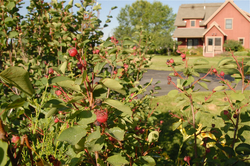
 With all of the rain this spring, our berry bushes are bursting!  Each year we add more berry bushes around the ranch hoping to attract more birds.  Different species of shrubs provide berries for the birds throughout the seasons.  Here is a sampling of our berries as we move into the month of August.

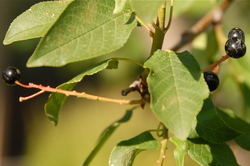
Canada Cherry (not yet ripe)-                                
Canada Cherry (uned.jpg
                    
Chokecherry- a favorite of the robin and waxwings.     
Chokecherry.jpg


Currants- different varieties with  
Current (uned.jpg
           
       different colored berries.  

Currant (uned.jpg


 Red-osier Dogwood- a personal                         
Dogwood.jpg
                       favorite of mine (and the birds).


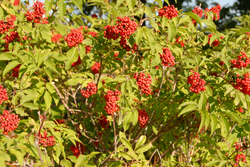
Scarlet Elder- beautiful red berries             
elder inedible 2.jpg
                                                                         that the birds never touch.


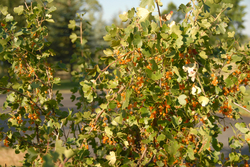
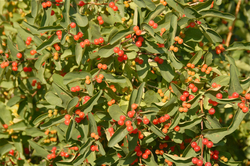
Honeysuckle- At least two different varieties- orange and red berries.                 
Honeysuckle.jpg
    

Raspberries- just planted last year.           
Raspberry (uned).jpg


Serviceberry- pronounced "Sarvisberry"
     and devoured by the most species
     of birds on the ranch.                        
Serviceberry.jpg


More about Young Orioles

| | Comments (0) | TrackBacks (0)
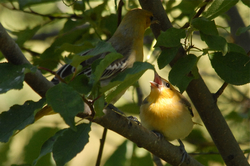
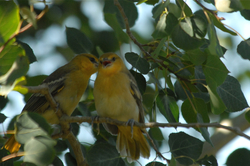
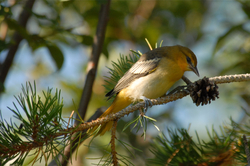
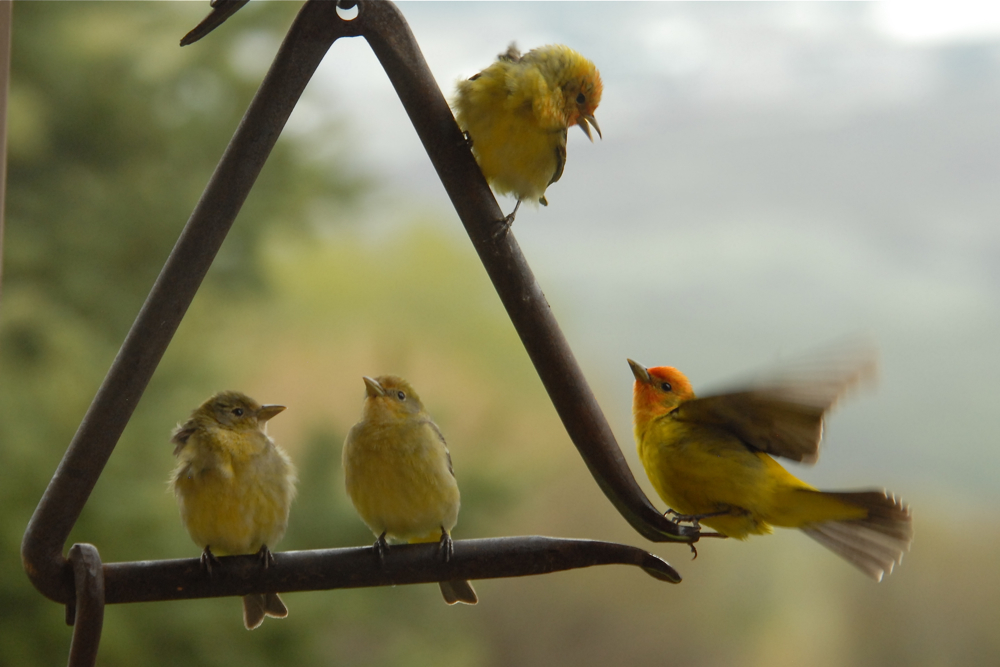
This spring produced a bumper crop of young Bullock's Orioles.  All day long I hear them chattering and begging for food from the tired adults.  I can't resist photographing them from the balcony of our bedroom which is eye level with the trees where they spent most of their day.
oriole begging.jpg

 oriole siblings.jpg
                                       
Young oriole in pine.jpg


Young oriole preening 2.jpg


Baby Birds and Fledglings

| | Comments (1) | TrackBacks (0)
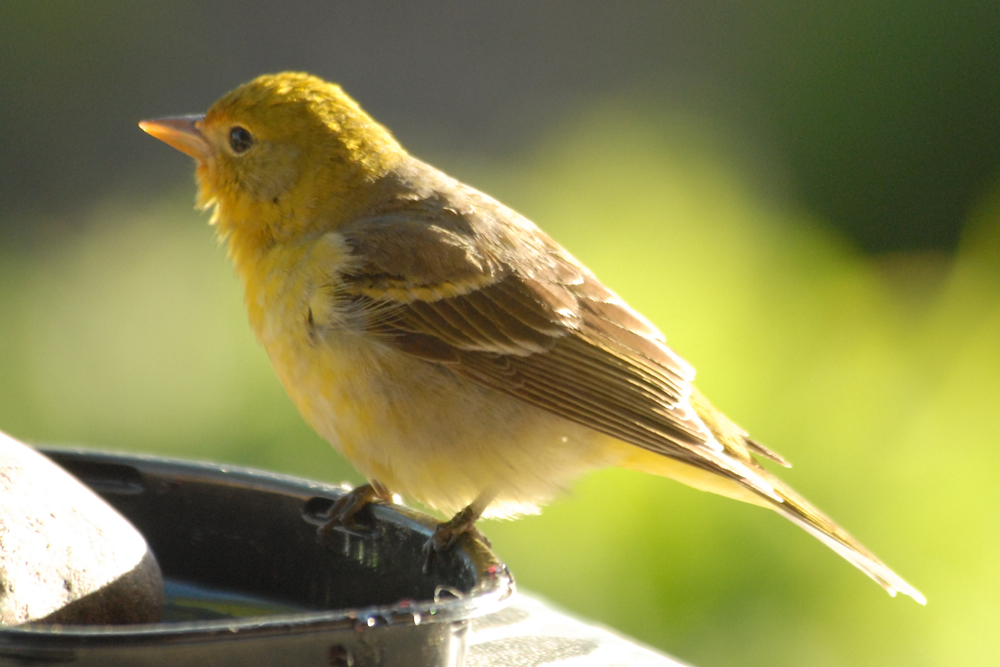
The first round of nesting on the ranch has been completed.  Some birds, such as the Barn Swallows and American Robins, will nest again, but most species have completed the nesting cycle for this year.  The fledglings perch awkwardly in the trees and shrubs, and all too often crash into windows, sometimes with catastrophic results.  Yesterday three young Bullock's Orioles visited our water feature and nectar feeders.young oriole.jpg                                                
They waited in the lilac tree until the adult oriole had drunk its fill at the feeder. 
Then they took turns eating at the feeder and bathing in the water feature.


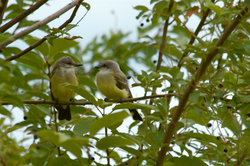
Today, young Western Kingbird siblings appeared to be carrying on a conversation in the shrubs outside our dining room window. 
Kingbirds young.jpg


I was not sure where the Kingbirds had nested this year on the property, but clearly they
had successfully raised a brood somewhere nearby.


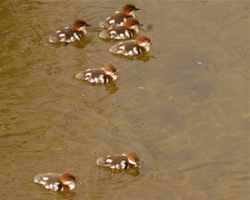
Earlier in the week on my walk along the river, I spotted seven Common Merganser babies swimming in the irrigation ditch that flows through our property.  
7 merganser babies.jpg


What cute little feathery puffs of joy! 


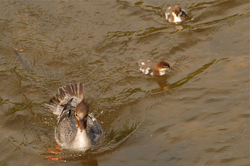
As I started snapping photos, Mama Merganser suddenly appeared and headed right toward me.  She was not happy that I was standing so close to her little flock.  

Mommy merganser & babies.jpg
I left quickly, hoping that these ducklings will stay safe in the waters around the ranch and grow up to nest somewhere nearby- perhaps in the duck box I installed two years ago by the banks of the river that, so far, has gone unoccupied.  

Nest Boxes and Their Occupants

| | Comments (0) | TrackBacks (0)
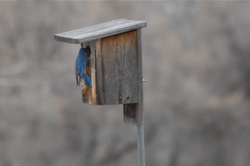
Almost as soon as we acquired the ranch, we began putting up nest boxes. Initially, our target bird for the nest boxes was the Mountain Bluebird- the only bluebird that breeds in our 
Bluebird at Box.jpg
area.  In 1999, I contacted the North American Bluebird Society and purchased ten Mountain Bluebird boxes; the holes in these boxes are sized specifically for Mountain, as opposed to Western or Eastern Bluebirds.  The installation of these boxes proved to be quite an ordeal.  Because we are located on river bottom land, our soil is incredibly rocky.  We had to pound rebar into the soil to make the holes for the poles to which the nest boxes were attached. When the job was completed, we discovered that the Mountain Bluebirds were happy to check out the boxes in the spring, but moved on to greener (or, more likely, higher) pastures to build their nests and raise their young.

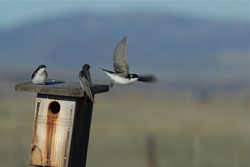
3 Tree Swallows.jpg
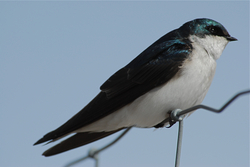
Instead, the Mountain Bluebird nest boxes became Tree Swallow boxes.  Every spring Tree Swallows in great numbers descend on the ranch and fight over the nest boxes.  The Tree Swallows have a beautiful, swooping flight and are prodigious insect-eaters, so they are welcome tenants.  They have successfully raised brood after brood of young, so that now Tree Swallows are the most numerous of any bird species to be found on the ranch. 

Large Tree Swallow.jpg
Over the years we have put up nest boxes for Northern Flickers, American Kestrels, Wood Ducks, and House Wrens.  Although flickers are numerous on the ranch, they seem to prefer natural tree cavities to our nest boxes.  The kestrel box has been occupied for the last two years; the smallest of the falcons, the kestrels are thrilling to watch as they hover over the fields hunting for mice and voles.  The Wood Duck box has never been occupied, although we have seen Wood Ducks- a rare species in this area- on the ranch.

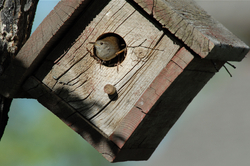
wren in hole.jpg
The wren boxes get used year after year.  While the House Wren can be classified as an L.B.J. (Little Brown Job), he more than makes up for his plain looks with his bubbly, energetic song. 
wren singing.jpg
In the spring and summer, nothing makes me happier than watching our nest box occupants fly to and fro as they build their nests and raise their young inside the homes we have provided for them.

Bird Beauties of the Ranch

| | Comments (0) | TrackBacks (0)
As a rule, I dislike beauty contests.  In humans they tend to focus primarily on physical attributes and objectify the contestants.  In reality, the majority of humans are equivalent in beauty to what we classify in the bird world as L.B.J.'s ("Little Brown Jobs").  When it comes to birds, however, I admit to having no qualms about making judgments concerning the relative beauty of different species.  In the bird world, the male of the species is typically (but not always) flashier and prettier than the female. So in considering the bird beauties of the Yampavian Ranch, I will focus on the males, making this a kind of "Mr. Universe," rather than a "Miss America" contest. 

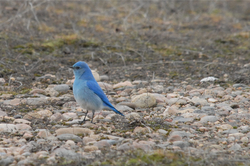
Mountain Bluebird.jpg
In my bird beauty contest, third runner-up goes to the Mountain Bluebird, a breathtaking, brilliant, sky-blue bird who has migrated through, but never nested on the ranch, despite the ten bluebird boxes we have scattered around the property.


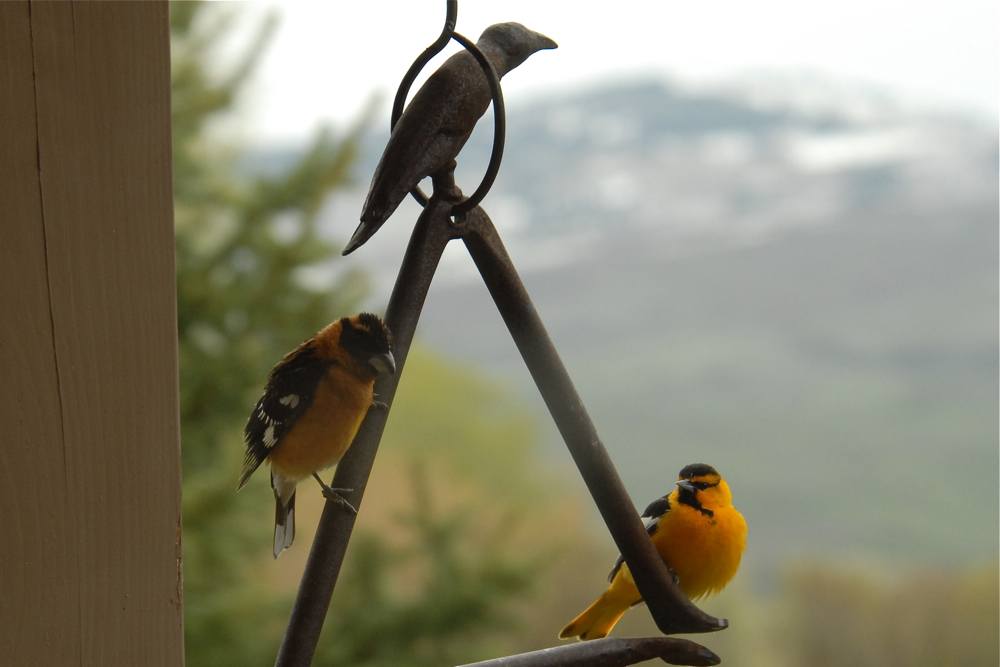
Second runner-up goes to the Bullock's Oriole, the orange, black, and white bird who is a regular at my nectar feeders in the spring and summer and whom I have discussed in one of my previous blog entries.
Oriole (beauty).jpg


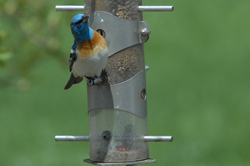
First runner-up goes to the Lazuli Bunting, another strikingly beautiful "blue" bird with deep blue feathers covering his head and back, a red--orange chest, and a snow white belly.  He shows up occasionally at my feeder in the spring and can be found regularly throughout the summer foraging for insects in the cottonwood trees along the river.
Lazuli Bunting at feeder.jpg


AND THE WINNER IS...................................
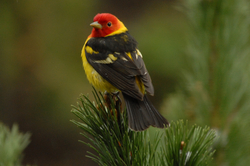
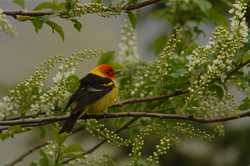
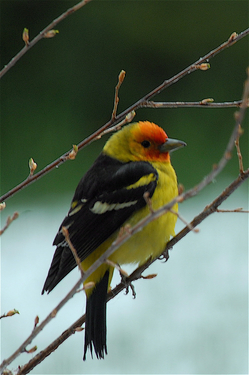
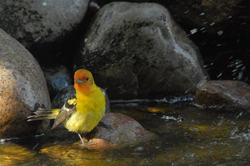
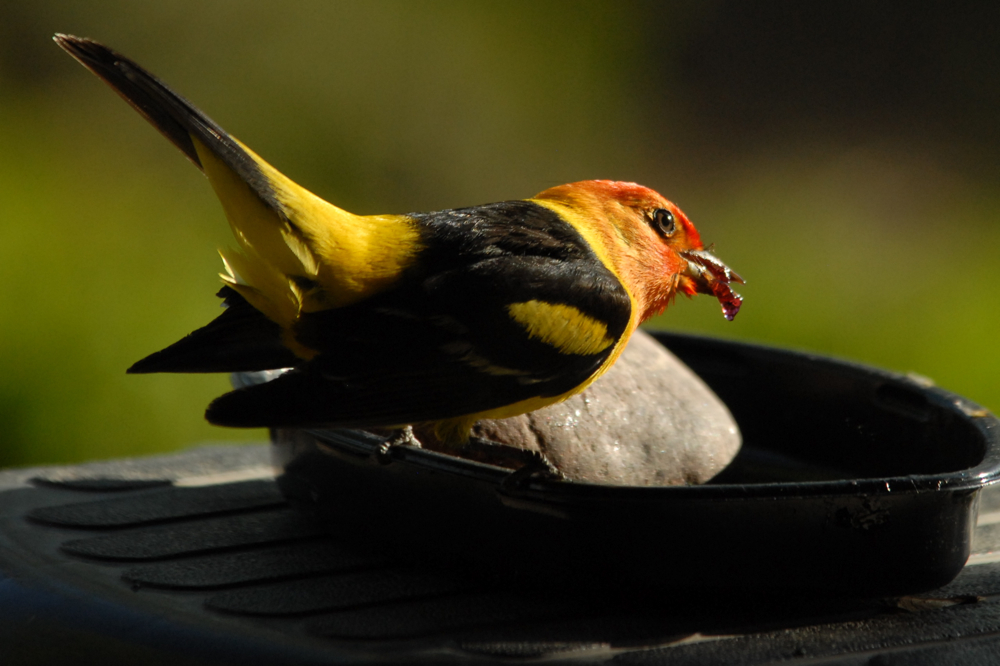
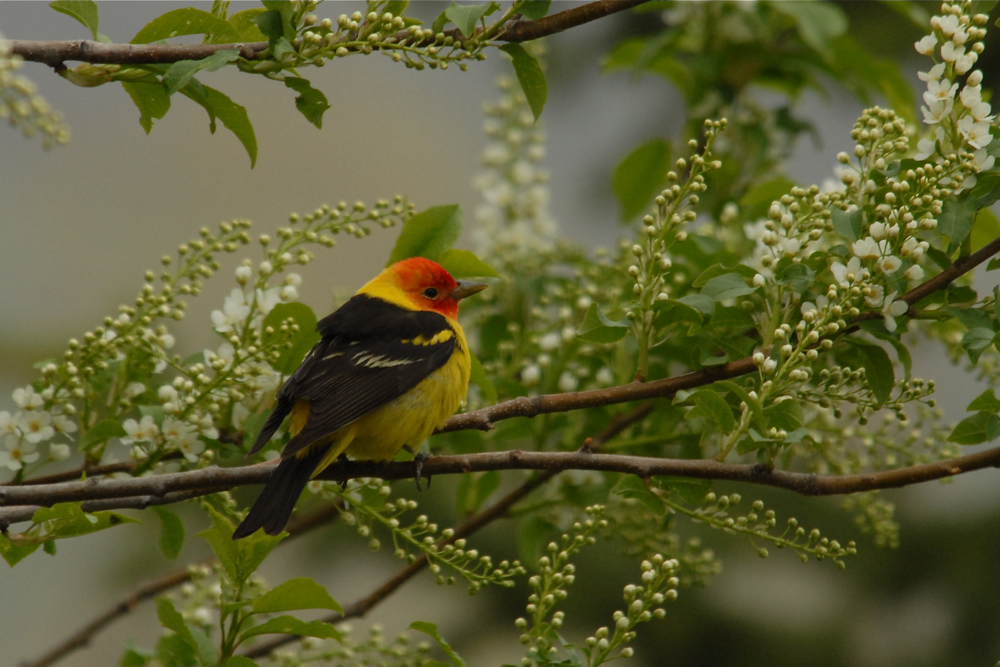
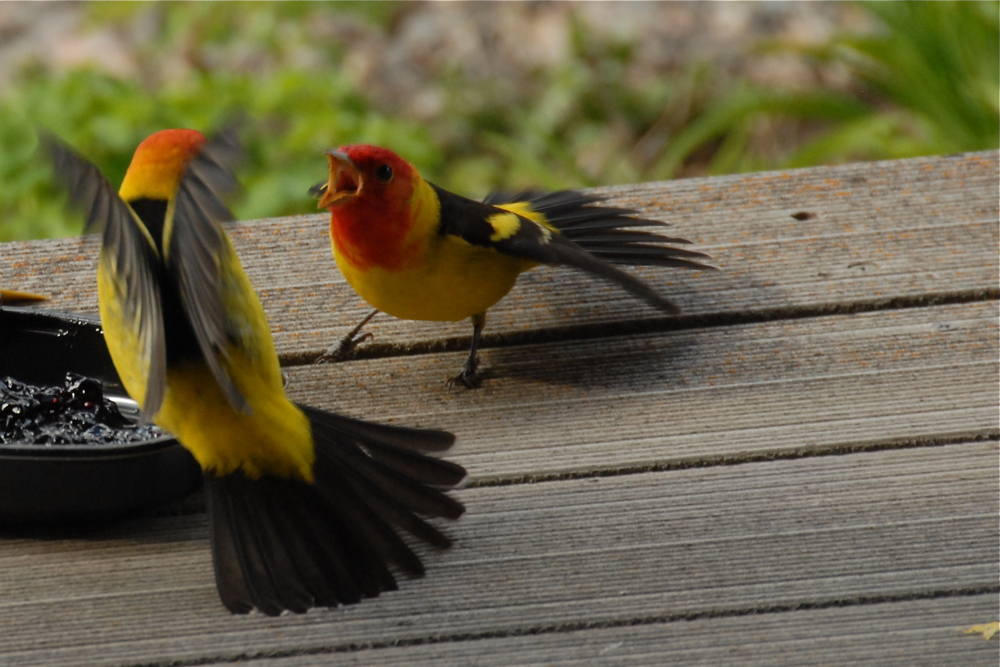
              WESTERN TANAGER!!!!

Western Tanager 1.jpg

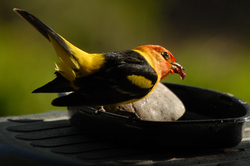
With his brilliant red head, his bright yellow body, and his black wings, tail, and back, this bird looks as if he has been painted by a wildlife artists.  A relative of the Cardinal, he winters in the tropics and breeds as far north as Alaska.  He shows up on the ranch in late May and is attracted to my water feature and to the fruit that I set out for the orioles.  Last Thursday, a "season" of Western Tanagers (a group of tanagers is called a "season") appeared in my back yard and drank and bathed while I watched in awe.
                        
Tanager 2.jpg

Waxing Eloquent Over Waxwings

| | Comments (2) | TrackBacks (0)
Cedar Waxwing 1.jpg
Cedar Waxwings are among the most elegant of the birds that frequent our ranch. With their long crest, their sleek brown and gray plumage, yellow tail band, and red waxy wing tips, they dazzle me when they flock to my trees.  Waxwings get their name from the red waxy wing tips found at the end of the secondary flight feathers in adult birds.  The color comes from carotenoid pigments in their fruit diet.  Young waxwings have little or no red in their wing tips.
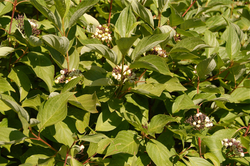
 Cedar Waxwings can show up at any time of the year, but they are most reliable around Memorial Day.  Yesterday our fruit trees were laden with blossoms and Cedar Waxwings.  As I  planted flower boxes, I watched the waxings fly from tree to tree and gorge themselves on buds,
Cedar Waxwing 3.jpg
 blossoms, and insects.  Later in the spring and summer, they will return to eat the berries from our various fruiting trees and shrubs. In the fall they will re-appear to eat whatever fruit there may be left over on the trees. Sometimes when they feast on this over-ripe fruit of the fall, they behave as though they are "inebriated," and I worry about their navigating skills when they take wing. 


The Bohemian Waxwing is the larger, grayer cousin of the Cedar Waxwing.  Bohemians live further north and only visit our area in the fall and winter.  We had one show up at the ranch  for a rare visit one fall several years ago.

In landscaping the ranch, the Cedar Waxwing was one of our target birds.  We planted
serviceberry, dogwood, hawthorne, chokecherry, sand cherry, strawberries, currants, viburnum, and other native fruit trees and shrubs in the hopes of attracting waxing flocks.  I am happy to report that we have succeeded in this endeavor beyond our wildest imagination.


Cedar Waxwing-2.jpg

Oriole Buffet

| | Comments (0) | TrackBacks (0)


Every spring the orioles show up at the ranch the first week of May.  I make a point to hang out a sugar-water feeder the last day of April in anticipation of their arrival.   In Northwest Colorado, we are frequented by one species of oriole- the Bullock's Oriole, which is similar in appearance and call to the Baltimore Oriole.  The Bullock's is found mainly in the west, while the Baltimore is the oriole of the east and midwest.  Because the two species sometimes hybridize where their ranges overlap, they were at one time lumped together as one species- the Northern Oriole. Then the powers-to-be of the ornithological world decided that they were actually two separate species, after all. The Bullock's Oriole is a stunner- the male is bright orange-gold in color with white wing-bars and a black throat.

male oriole at full feeder.jpg


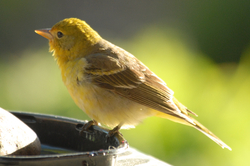
The female is a paler orange and lacks the black on the throat. 

female oriole.jpg

. 

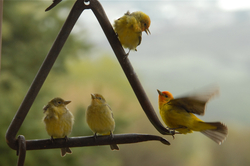
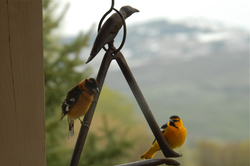
Once the first oriole appears at the feeder (always a male), I put out the whole oriole buffet.  In addition to the nectar feeder, I provide orange halves in a suet feeder and grape jelly in a dish.  The orioles are voracious eaters and will sit in the tree and chatter at me to replenish the buffet if it starts to run low. 

oriole buffet.jpg

I have had as many as 4 orioles waiting their turn at the buffet line. (Actually, they don't wait politely, they butt in line whenever they see an opportunity.)  In addition to sugar-water, jelly, and oranges, the Bullock's Oriole consumes protein in the form of insects, which are plentiful everywhere on the ranch. 


 A short time after their arrival, the orioles begin building their incredible hanging pouch nests around the ranch.  They usually place their nests in cottonwood trees at the end of a slender branch.  They nests are well-hidden in the foliage, so that it isn't until fall (and long after the babies have fledged) that we are able to determine where they have nested.                                                       

oriole nest 2.jpg


From the time of their arrival, throughout the nesting season,  until they depart at the end of the summer, they continue to frequent the oriole buffet and continue to dazzle us with their brilliant color.


  Male Bullock's.jpg


The Colors of Mud Season

| | Comments (2) | TrackBacks (0)


While I love all the seasons on the ranch, mud season- the period of time between the closing of the ski mountain in mid-April and the arrival of summer in late May- is my favorite.  The tourists have gone home, and many of the locals leave town for a few weeks for warmer climes.  The weather varies dramatically from day-to-day - sunny, rainy, snowy, blowy.  Flocks of birds migrate through the area, while other flocks stay and begin the breeding cycle. 

Daffodils in snow.jpg

As the snow melts, the ranch transforms itself practically overnight from white and brown to a dazzling green - so green it almost hurts your eyes. Green grass, green buds, green leaves, even green frogs cover the landscape in all directions.  And shortly following the greening of the ranch, splashes of yellow begin to appear.  Golden daffodils bloom in my front and back garden, sometimes poking through the white snow that has fallen overnight.  The dull brown winter plumage of the American Goldfinch suddenly transforms to the bright

Goldfinch.jpg

 canary yellow that seems more typical of tropical species rather than North American birds.  But my favorite yellow - a kind of yellow-orange - shows up in the form of a single Yellow-headed Blackbird that visits the ranch each spring.  I know he has arrived when I hear his raucous call, reminding me of the sound of a rusty hinge. (Click hear to hear his song).  He sports a brilliantly yellow head, neck, and chest, and flashes white wing patches when he flies.  He joins the throngs of other blackbirds that frequent my feeders during mud season, but with his flashy yellow coloration and his unique call, he grabs the spotlight. 

Yellow-headed Bl.jpg